
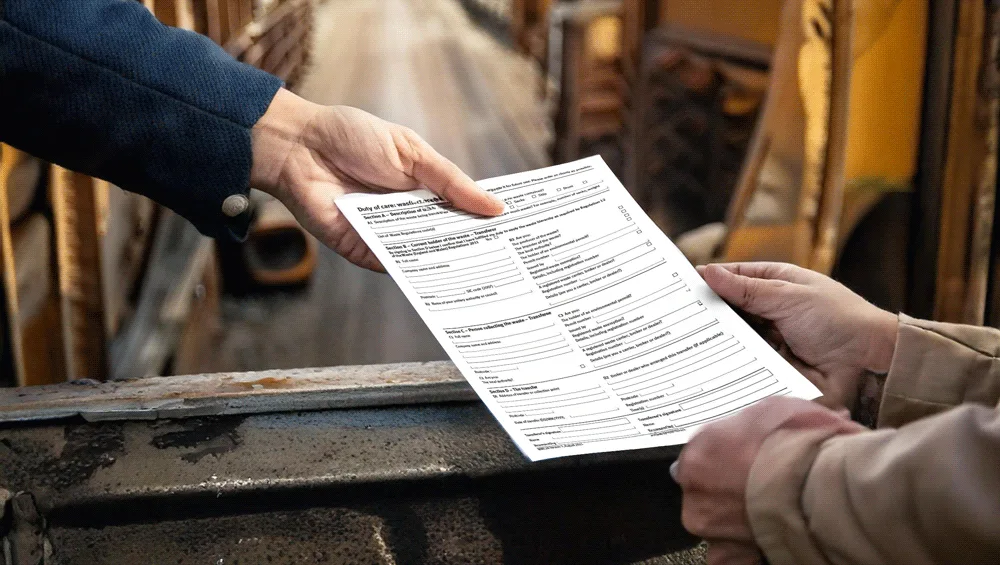
If you have ever had a skip on your drive or paid someone to clear a garage, you have probably been handed a slip of paper at the end. That slip is a waste transfer note, and it is the single most important document in the whole transaction.
What a waste transfer note actually is
A waste transfer note (often shortened to WTN) is a written record of a transfer of waste from one party to another. Under the Environmental Protection Act 1990 and the Waste (England and Wales) Regulations 2011, anyone who produces, carries or receives controlled waste must describe it accurately and keep a record of what happened to it.
In plain terms: it says what the waste is, how much of it there was, where it came from, who took it, where it went, and when.
The details that must appear on it
A compliant note is not a scribbled receipt. It needs:
- A description of the waste, including the type and quantity
- The European Waste Catalogue code for the material
- The address the waste was collected from
- The name and signature of the person handing it over
- The name, address and carrier registration number of whoever takes it
- The destination site and its permit or exemption number
If any of those are missing, the note does not do its job.
Why you should always ask for one
There is a duty of care on the householder or business producing the waste. If your rubbish is fly-tipped by someone you paid in cash with no paperwork, the trail stops at you. Councils can and do issue fixed penalties to the person whose waste it was, even when they had no idea it was dumped.
A waste transfer note moves that liability to a registered carrier who can prove where the material went. It is the difference between a cleared garden and an unexpected fine.
How long to keep it
Businesses must keep transfer notes for at least two years. Hazardous waste consignment notes must be kept for three. Householders are not legally required to retain them, but keeping the note until you have had your waste collection receipt checked is sensible.
What to check before you book anyone
Ask three questions before any collection:
- Are you a registered waste carrier, and what is your registration number?
- Will you give me a waste transfer note at the end?
- Where will my waste actually be taken?
Anyone who hesitates on any of those is not someone you want removing waste from your property.
The bottom line
A waste transfer note costs you nothing and protects you completely. If a company cannot produce one, they are not a licensed waste carrier, and the rubbish they take from you becomes your problem again the moment it leaves your gate.